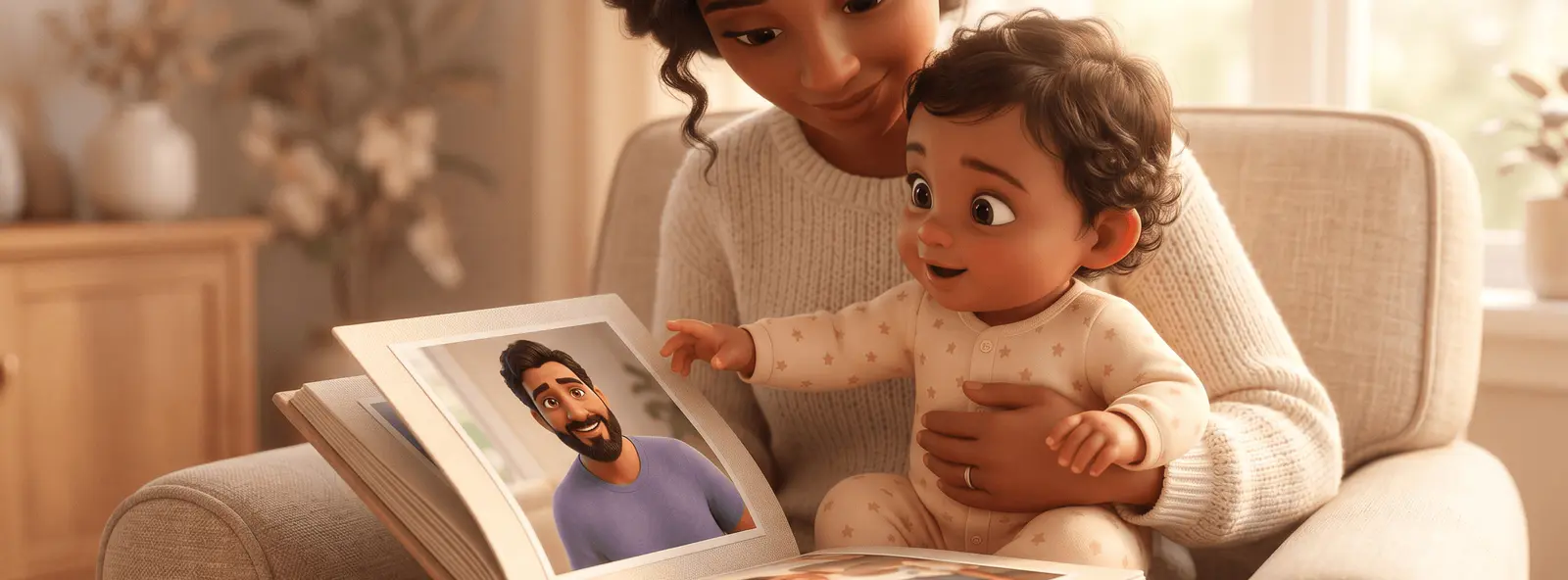

Place a personalised photo book in front of an eight-month-old baby. Just watch their eyes. They stop dead on a familiar face — mum, dad, or whoever rocks them to sleep at night. Their hand reaches out and, for instance, their fingers tap the page. Something lights up. This scene plays out for many little ones, and it's no coincidence.
An infant is wired to respond to faces long before they walk or talk. And towards the end of their first year, then in the months that follow, they also begin to recognise themselves. That's why these pages capture their attention so much.
Babies are wired for faces
From the very first weeks, an infant prefers looking at a face rather than any other shape. Two eyes, a nose, a mouth: this pattern draws them in instinctively. What's more, they gaze longer at their parents' features — the ones they see during feeding, bath time, and cuddles. The face thus becomes their first point of reference in a still-blurry world.
Next comes recognition. Around four to six months, many babies clearly tell close family apart from strangers. The Naître et Grandir website, on baby development, points out just how early this attention to familiar faces develops. A loved face on a page therefore speaks to your baby in a language they already understand.
Seeing their own face: why a personalised photo book stops them in their tracks
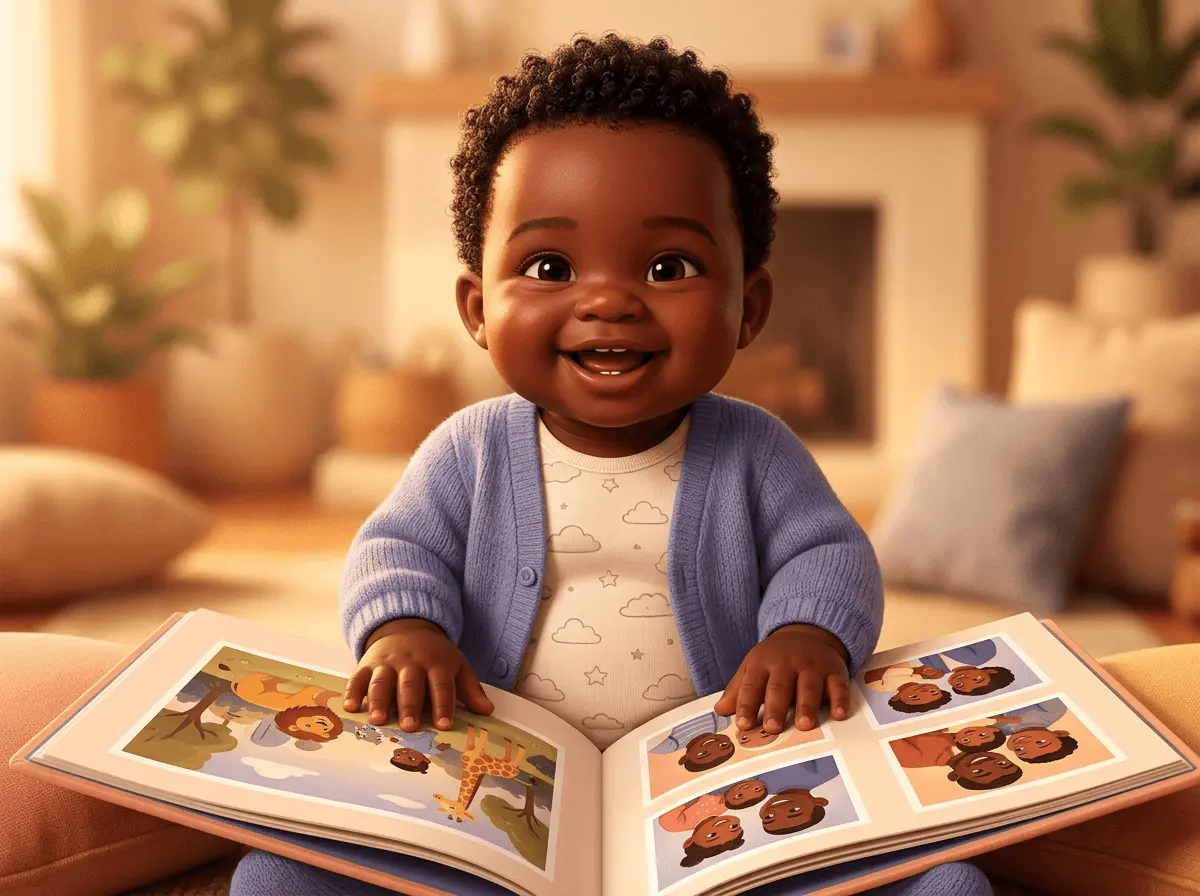
Picture Sofia, ten months old. On the page is her own little face, her big sister's, and her dad's. She can't read a story yet, of course. Yet she recognises her world. She sees these faces every day. That's why finding them again in something she holds in her hands creates a tender surprise, almost a game of peekaboo.
This is the real power of a personalised photo book. It doesn't ask the baby to understand complicated words. It offers them what they already know how to spot: familiar heads, familiar smiles. In practice, the little one points, babbles, taps the page, and asks for it to be turned. As a result, their attention lasts far longer than with a book full of strangers.
What's more, the first name plays its part. A baby responds very early to the melody of their own name, that sound whispered to them a hundred times a day. Hearing it while leafing through the pages together adds one more thread to this shared moment.
Recognising yourself: the famous mirror test
Recognising others is one thing. Recognising yourself, though, is another — one that comes later and is even more fascinating. Researchers have studied this for a long time using the mirror test, sometimes called the rouge test.
The principle is simple. A small coloured mark is discreetly placed on the child's forehead or nose, then they're put in front of a mirror. Before a certain age, little ones treat their reflection like another baby: they smile, they pat the glass. Later, they reach up to touch their own face to find the mark, showing that, at that moment, they've grasped a dizzying idea: that reflection is me.
Psychologist Beulah Amsterdam laid the groundwork for this experiment with young children in the early 1970s. In France, psychologist René Zazzo studied this discovery of the mirror in children at length. Indeed, the research points to a cautious benchmark: self-recognition often appears between eighteen and twenty-four months, with wide variation from one child to another.
Recognising loved faces, then recognising oneself: two gentle milestones that a book can gently accompany, never rushing them.
When a child understands that it's them on the page
This mirror milestone also sheds light on what happens with images. At first, the baby loves familiar faces without necessarily grasping that one of them is their own. Then, little by little, it clicks. They point to themselves in a photo. They say their own name in front of their reflection. They laugh when they spot themselves on a page.
At this point, a book featuring the child takes on a whole new meaning. They're no longer just looking at familiar faces: they see themselves, the hero of their very own pages. This little spark of pride gently nurtures the idea that they exist, that they matter, that they have their place. Nothing dramatic, just a seed planted with each reading.
Of course, every child moves at their own pace. Some recognise themselves early, while others take their time — and that's perfectly fine. There's no need to test or rush anything. After all, the joy of being together over the pages matters far more than the exact date of the click.
Turning this moment into a tender ritual
Before nap time, after bath time, on your lap on the sofa. You name the faces, you mimic the voices. You let the baby turn the pages however they like, sometimes upside down. It's these repeated gestures that leave a mark, far more than the object itself.
Over the months, reading grows alongside the child. First they point at faces. Then they name them. Later, they ask for the story to be properly told, again and again. At Real Big Stories, we love this idea of a book that accompanies these first discoveries, without ever rushing them.
If you'd like to give it a go, you can give your baby their very first book in which they recognise themselves. A loved face, a whispered name, pages turned together: this is often where the simplest and most lasting memories are born.
Next time your little one stares at a page and reaches out, watch them closely. In their own way, they're telling you they've recognised someone. And perhaps, one day, that someone will be themselves.