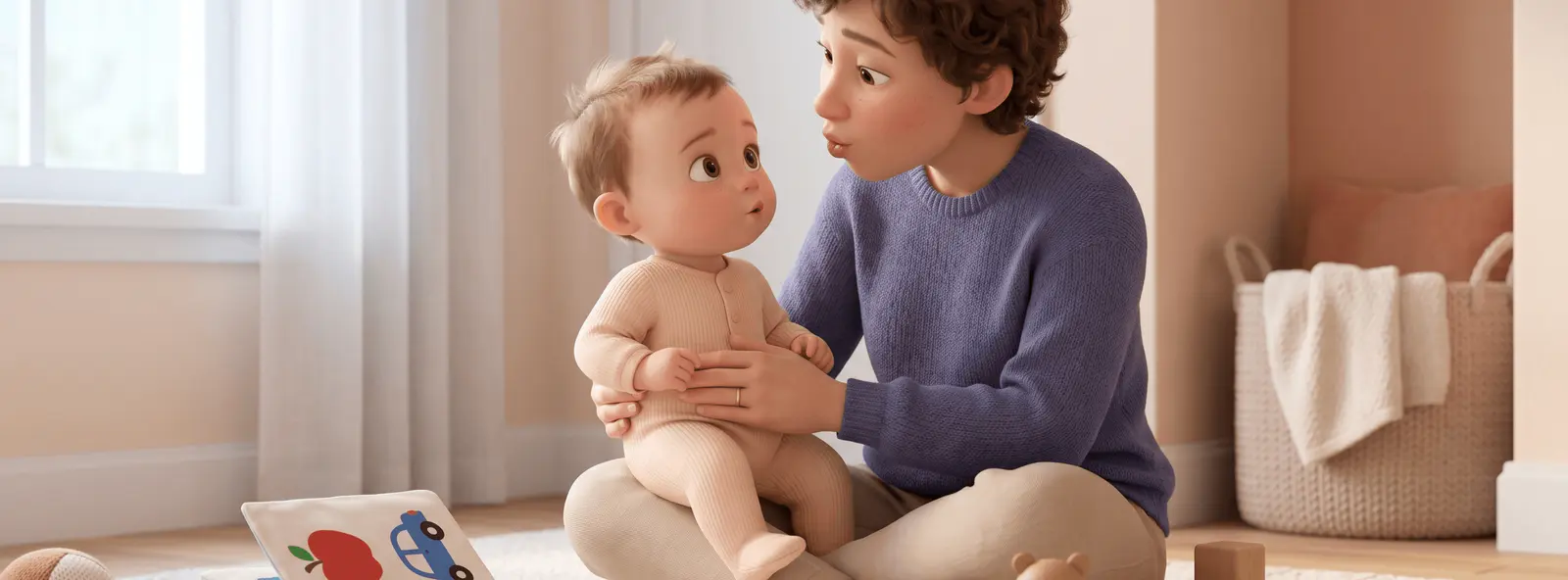

Sofia, 18 months old, says "car", "dad", "more", and three or four other words. Her cousin of the same age, however, already says fifty, which worries her mum. Six months later, Sofia is speaking in short sentences and naming colours. What she was going through was neither a delay nor an advance: just one rhythm, among many others, of language development from 0 to 6 years old.
Here are the 7 stages identified by research, what's at play in each one, and the concrete markers to help you understand where your child stands. First and foremost, bear in mind that there's a great deal of normal variability between children. What matters is the trajectory, not the precise timetable.
Stage 1: pre-verbal communication (0 to 6 months)
Long before the first word, your baby is already communicating. Distinct cries, social smiles from around 6 weeks, cooing at 3 months, responses to your gaze. Patricia Kuhl, at the University of Washington, showed that by 3 months, a baby's brain already distinguishes the sounds of its mother tongue from those of other languages. The language you surround them with is already shaping their sound map.
What you can do: talk to your baby even when they don't respond, sing, describe what you're doing. Fabric picture books and very simple board books (colours, contrasts) start to draw interest from around 4-5 months.
Stage 2: first syllables (6 to 12 months)
Babbling becomes more sophisticated: "ba-ba-ba", "da-da-da", then "dada" and "mama" around 9-12 months. These first words aren't yet linked to meaning for every baby, but the imitation of sounds is clear. At this age, children understand far more than they can say.
Lucas, at 11 months, only said "dada" and "woof". Yet he understood "give", "look", "come here", "more", and "clap your hands". This gap between understood and spoken language is completely normal and will last for several years.
Stage 3: the word explosion (12 to 24 months)
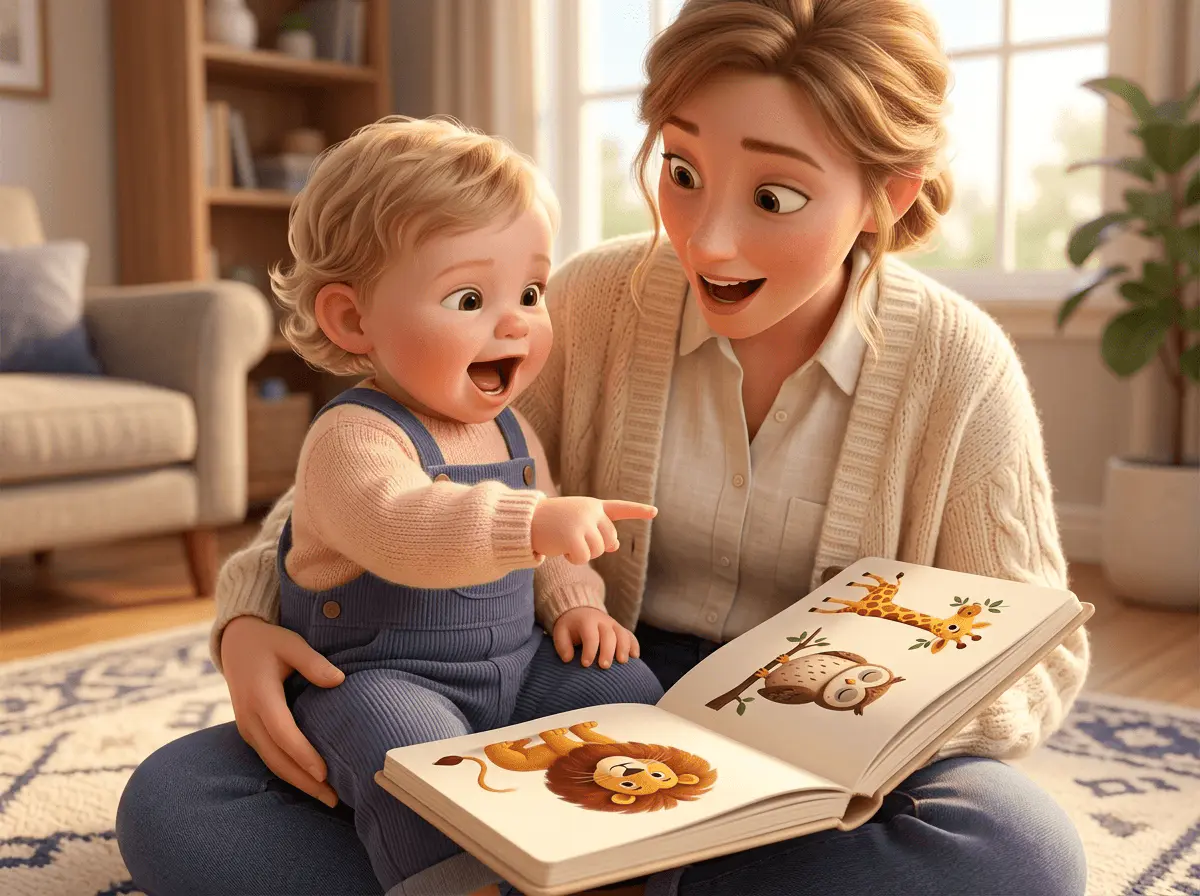
Between 12 and 18 months, children have on average 10 to 50 words. Between 18 and 24 months comes the explosion: they can pick up a new word every day. Daniel Stern, in his research on early development, described this as a genuine neurological threshold. This is also the age when the first two-word combinations appear: "more milk", "daddy gone".
There's huge variability at this stage. Some children say 20 words at 18 months, others say 200. Progress matters far more than the total count.
Stage 4: first sentences (2 to 3 years)
Children build their first three- or four-word sentences, then move on to five or six words. Grammar remains simplified ("me want cake") but the meaning gets across. This is also the age when grammatical overgeneralisations appear. For example, saying "I goed" instead of "I went" shows the child applying a rule they've grasped, before learning the exceptions.
At this age, bedtime stories really come into their own: daily reading massively boosts passive vocabulary, which will turn active six months down the line.
Stage 5: storytelling (3 to 4 years)
Children move beyond simply naming things: they start telling stories. "Yesterday, we went to the park and there was a big dog and it was barking." Narrative skills develop, strongly nourished by the stories they've heard. Catherine Gueguen puts it simply: a child who is read stories learns how to structure their own.
This is also the age when the "whys" appear. Not to be provocative: it's a cognitive exploration of cause and effect, which will go on to shape all future thinking.
Stage 6: grammatical complexity (4 to 5 years)
Children master most tenses (past, present, future), build complex sentences, and understand inferences ("if... then..."). Their active vocabulary tops 2000 words on average, and their comprehension goes well beyond that. At this stage, verbal humour also starts to emerge: wordplay, simple tongue-twisters, jokes about sounds.
Inès, aged 5, makes her parents laugh by inventing blended words ("elephantom", "crocodelicious"). It's not just funny: it's a sign that language awareness is well and truly in place.
Stage 7: metalanguage (5 to 6 years)
Before starting Year 1, children develop an awareness that language itself is something to be examined. They know that a word has syllables, that two words can rhyme, that the same word can have several meanings. It's this phonological awareness that makes learning to read possible. Without it, reading would be far more difficult.
Nursery rhymes, rhyming games, and books with repeated sounds (such as the picture books by Claude Ponti or Christian Voltz) directly nourish this stage.
When to seek advice without panicking
Normal variability is wide-ranging. However, a few markers do warrant a professional opinion from a speech and language therapist or paediatrician, without alarm: no babbling by 12 months, no first word by 18 months, no two-word sentences by 24 months, no constructed sentences by 3 years, speech unintelligible to an unfamiliar adult by 4 years. The website 3 à 5 ans de Naître et Grandir offers precise markers for each age.
One reassuring marker: a child who doesn't yet have the expected vocabulary but understands everything said to them will almost always develop their spoken language in the following months. Indeed, the gap between comprehension and expression is entirely normal up to 2-3 years old.
What really helps, at every stage
The one constant across every stage: the quantity and quality of language a child hears. Not the number of educational apps. Not "expert" methods. Simply having an adult around who talks, reads, sings, and tells stories. This is exactly why daily reading is the most worthwhile investment parents can make for their child's language development.
If the idea of a book where your child is the hero of their own story appeals to you, as one of many shared reading experiences, you can create their personalised story with Real Big Stories. The heightened attention it sparks (thanks to the identification with the character) boosts the language benefits of reading even further. But the most important thing remains simple: keep talking, singing, and reading aloud, one stage at a time.