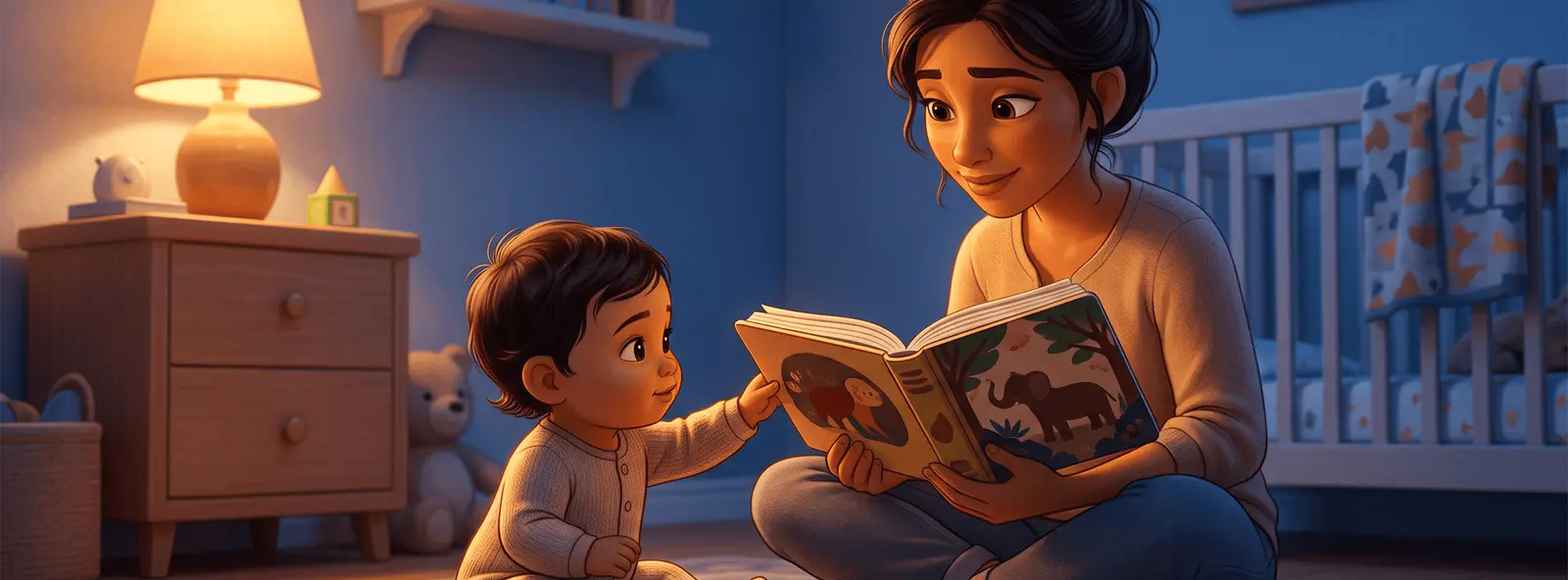

Reading a bedtime story to a baby seems absurd the first time. He doesn't understand the words, he grabs the book to chew it, he turns three pages at once and turns away to grab something else. Many parents give up at that point, concluding it's too early.
Yet what's really happening at this age has nothing to do with the story itself.
What the baby is really listening to
Before the age of two, the child receives, above all, a voice. The rhythm, the changes in pitch, the slowed pace, the pauses: all of this has an effect long before meaning arrives. An eight-month-old baby recognises the melody of a sentence repeated every evening, without understanding a single word of it.
What's more, they pick up on posture. A parent sitting still with an object in their hands sends a very different signal from a parent standing up and tidying the room while talking. In practical terms, it's the whole scene that prepares the child for sleep, not the text.
This is why a story read badly, quickly, or made up on the spot works just as well as a masterpiece, as long as the voice stays steady and the moment comes back every evening.
The right length before the age of two
Two to four minutes is more than enough. Beyond that, attention drifts and the ritual turns into a struggle, which produces the opposite of the intended effect.
So it's better to read an eight-page board book twice than to interrupt a thirty-page picture book halfway through. Repetition is reassuring; length is exhausting.
A simple rule of thumb: stop before he turns away. If he reaches for something else, close the book without comment. Indeed, the ritual should remain something pleasant, never a rule to be followed.
Which book to choose as a bedtime story for a baby
Board books stand up to teething and to pages turned with four clumsy hands, which solves the main practical problem. Choose high-contrast images before the age of one, then pictures of everyday objects afterwards.
That said, content matters less than structure. A book with a sentence repeated on every page, a phrase that keeps coming back, a sound the child anticipates, works better than a rich text. He waits for the moment, he recognises it, and this anticipation soothes him.
Picture dictionaries do the job just as well. Naming a dog, a ball, a spoon, always in the same order, makes for a perfectly valid story at this age.
Making it up rather than reading
Many parents make up stories, often out of tiredness, sometimes because the book has vanished under the bed. It's an excellent option, and it has one advantage: you can weave in his day.
Tell him what he did, in order, using short sentences. The park, the dog that barked, the spilt purée, bath time. This retelling of the day does two things at once: it soothes him and it builds his memory of events.
Always end the same way. A ritual phrase, exactly the same every evening, signals the end better than any tone of voice.
When nothing works
Some evenings, the story doesn't soothe anything at all. Teething, a day that was too busy, a missed nap: the ritual doesn't stand a chance, and persisting is pointless.
In these cases, shorten things rather than push on. A nursery rhyme, the light, the door. The next day, start again as if nothing happened: the ritual is judged over weeks, not a single evening.
However, if falling asleep becomes a nightly battle for several weeks, speak to your GP or health visitor rather than piling up methods found online. For well-documented guidance on this period, the official French '1000 first days' programme covers sleep in young children.
Why his first name changes everything
Around the age of one, the child picks out his own name from a stream of speech long before understanding anything else. He turns his head, he smiles, he listens more closely to the sentence that follows.
So slipping his name into the story instantly grabs his attention. Some families use a book built around him for this very reason: he becomes the character, and he senses it well before he can say so.
If you'd like to give him this kind of story, you can create the book where he's the one with his own name.
He won't remember any of these stories. He'll still keep the reflex of reaching out for a book at eight o'clock in the evening.