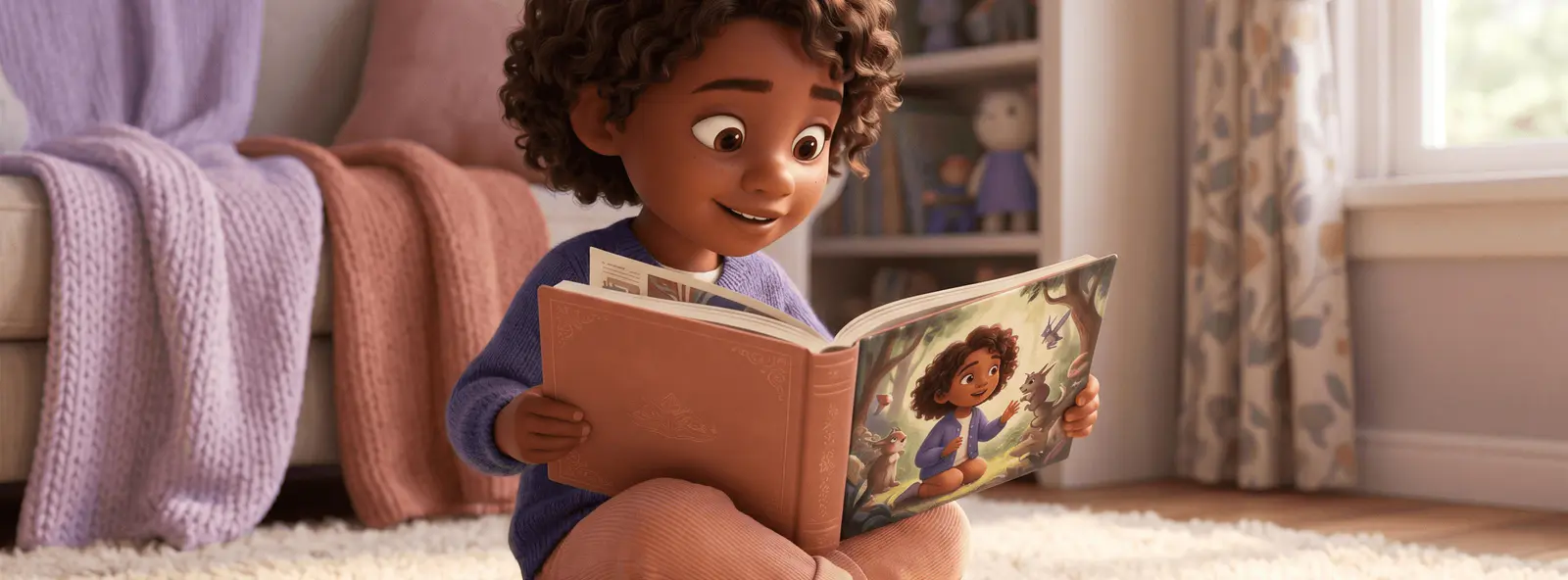

Indeed, Inès, aged 5, has a bookshelf full of books. Yet she always brings home the same one from the library: the one where the heroine wears glasses just like her. This is no coincidence. Seeing a character who resembles her, or even seeing herself in a personalised book, triggers something quite specific in her mind, and psychology has been shedding light on this for a long time.
Here's why your child needs to see themselves in their books, and what this builds within them over the long term.
The mechanism of identifying with the hero
Albert Bandura, in his social learning theory, showed as early as the 1960s that a child learns as much by observing a role model as by experiencing things themselves. If the model resembles them, learning is faster and longer-lasting. This principle, demonstrated through behavioural imitation, also applies to identity building.
In practical terms, in a personalised book, or when your child sees a hero who shares a recognisable trait with them (their first name, their face, their glasses, their skin colour, their family situation), their brain registers "this story is about me". As a result, they become more emotionally invested and remember the story better. They also draw on it for models they'll replay when facing their own challenges.
What psychoanalysis says about it
Bruno Bettelheim, in The Uses of Enchantment, shows that traditional fairy tales offer children a symbolic projection. Little Tom Thumb succeeding represents all children who feel too small in the face of the adult world. But this projection always works through a veil (the child isn't really Tom Thumb), and it's this veil that makes the projection feel safe.
Books where the child is themselves the hero, without any veil, work differently: they don't project, they confirm. Lucas watches Lucas overcome a difficult situation: he's no longer projecting, he's ratifying a possibility that directly concerns him.
Why it's even more powerful at certain ages
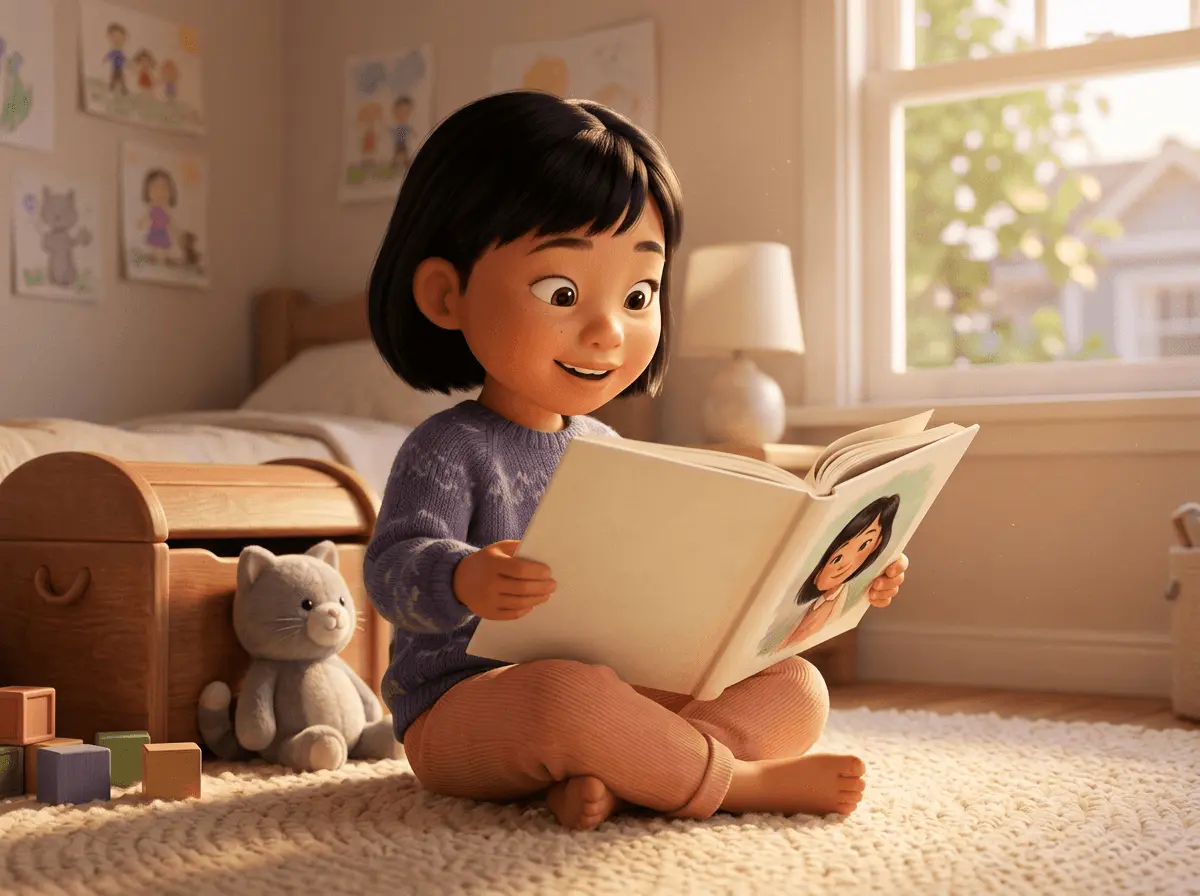
Between the ages of 3 and 8, identification is at its peak. At this age, children take things literally. For example, if the book says "Lucas overcame his fear of the dark", Lucas hears this as literal fact. The critical distance that will emerge around ages 9-10 doesn't exist yet. This literalness is exactly what makes personalised books particularly powerful between ages 3 and 8, and gradually less so for pre-teens.
Before age 3, however, recognition doesn't yet work as a narrative mirror: it's more of a sensory delight (hearing their name in a story, seeing their face). Precious too, but for different reasons.
What this builds over time
Three things, observable with a few years' hindsight. First, sturdier self-confidence: the child has "narrative proof" that they can get through difficult things, that they can be a hero too. Second, a more stable appetite for reading: they associate books with recognition, not just with school learning.
Finally, and this is less obvious, a diversity of imaginary role models enriches the child. For instance, Yaël, whose family is French-Moroccan, reads books where the hero resembles him both physically and culturally. He comes to understand that characters like him can be pirates, astronauts, or wizards. This openness, which no parental instruction could create, takes root through quiet bedtime stories.
When this becomes a more sensitive topic
For children from minority backgrounds, with disabilities, in blended families, who are adopted, or living in specific family situations, the lack of representation in books can weigh on them. This isn't about "quotas": it's simply that seeing no one who looks like you, page after page, ends up sending a message.
French children's publishers are making progress in this area (Talents Hauts, MeMo, Cambourakis, Père Fouettard). The 3 to 5 years section on Naître et Grandir also notes that for children in particular circumstances, this need to see themselves reflected is even stronger.
How to use this day to day
Without overthinking it. Also, vary the heroes (girls, boys, skin colours, family structures) without making a big deal of it. When your child finds a book that resembles them, let them reread it ten times without stepping in. It's through this free repetition that the benefit sinks in.
Additionally, once or twice a year, a memorable book that puts them directly at the centre of the story (birthday, Christmas, christening) reinforces this. Several brands offer personalised books where the child's face and first name are woven into the illustrations. However, quality varies: check that the face is genuinely drawn into the scene, not just the name printed on the page.
When the hero is truly them
When all these elements align (the face, the first name, a story that fits a particular moment in their life), the effect is immediate. Sofia, aged 4, reread her book, in which she's the heroine, seventeen times in two weeks. No one asked her to. This is the sign that recognition is doing its work.
If this idea appeals to you, you can create your child's personalised story with Real Big Stories using their photo and first name. Alongside this, keep a diverse bookshelf too: these are the two forces that work together to give your child both mirrors and windows.