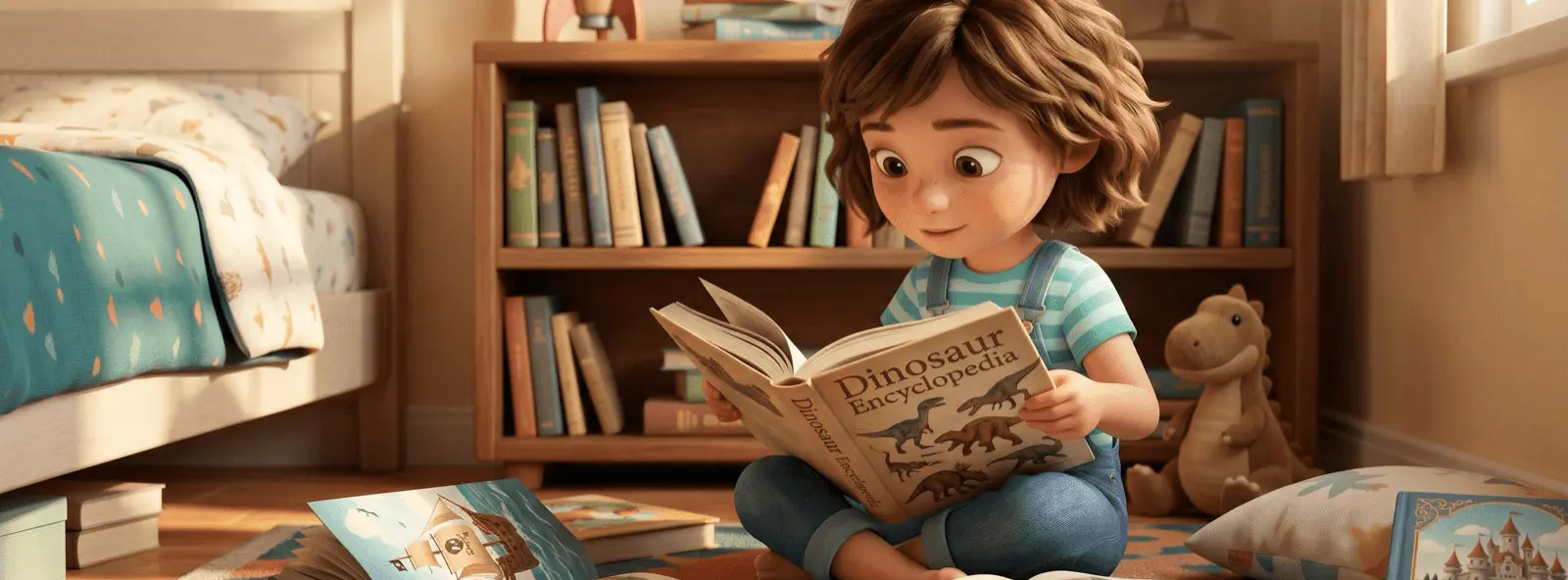

Sophie gave Léa, aged 6, a lovely collection of princess books. However, Léa flicked through it for three minutes and said, "No, I prefer my pirate books." Sophie feels torn. She wants to support her daughter's choice, but she feels a bit guilty: was she wrong to steer her daughter towards "girly" worlds, has she missed something elsewhere, should she insist?
Short answer: no, you haven't missed anything. Your daughter is rejecting a marketing category, not a part of herself. So here's why this is healthy, what it reveals, and how to support her without forcing anything.
"Girls' books" are a recent invention
"Girls' books" have indeed become a subject of debate around categorisation in children's literature. This relatively recent invention prompts us to reflect on cultural and marketing influences.
"Girls'" and "boys'" sections in bookshops have only existed since the 1990s. Before that, children's books weren't gendered at all. For example, the Comtesse de Ségur didn't write "for girls": she wrote novels, full stop. Likewise, Marcel Aymé didn't write "for boys". The idea that certain stories are for girls and others for boys is a recent marketing construct, not a psychological truth.
When your daughter rejects "girls' books", she's rejecting that categorisation, not reading itself. She's telling you that she wants to explore freely, without being assigned to a particular shelf.
What this reveals, positively
A girl who rejects "girls' books" generally develops three valuable skills: the ability to tell marketing apart from content (at age 6, that's rare and precious); curiosity beyond boundaries, which will serve her across every subject; and a sense of agency in her choices, which builds her independence.
According to research in comparative education, girls who have early access to varied worlds (adventure, science, technical subjects) tend to keep a wider range of career aspirations into adolescence. That's not insignificant.
What she really loves to read
Observe without judging. If Léa loves pirates, she probably loves adventure (the journey, the treasure, the risk). If she loves superheroes, she probably loves power (making things happen, being stronger than her fears). If she loves dinosaurs, she probably loves grandeur (gigantic things, ancient worlds).
All these passions are healthy, and none of them are gendered. Keep offering her books in these worlds, without wondering whether "it looks like a girls' book".
Pitfalls to avoid
A few classic mistakes: insisting on princesses "so she takes an interest in what's pretty" — your daughter will pick up on the pressure and resist even harder. Don't say "yes, but you can also like other things" as if it were a concession she has to earn: your daughter has already understood she can like both. It's you who's hesitating. Buying "girl versions" of boys' worlds (pink pirate princess, superheroine in a frilly dress) is the worst of both worlds — your daughter isn't fooled.
What works: keep offering her what she loves, while varying the nuances within that world (female pirates, boys who cry, superheroes who doubt themselves). Children absorb the richness of nuance far better than categorisation.
When she comes back to "girls'" worlds
Good news: at a certain age, your daughter may well come back to worlds labelled "for girls" without it being a problem. At 8–10, she might love fairy stories (because she loves magic, not because it's "pink"). At 12–14, she might love romance stories (because she's starting to ask identity questions, not because she's "become girly again").
What matters is that she comes back by choice, not by pressure. And she'll find it easier to return to these worlds if she hasn't associated them with coercion during her early years, from 4 to 7.
What childhood experts say
According to Catherine Gueguen, a child who can explore different worlds freely develops a more adaptable brain and a stronger sense of identity in adolescence. Conversely, a child who has a strict gendered model imposed on them builds their identity against that model (through rebellion or submission), rather than following their own compass.
For broader insights into a child's identity development, the website Naître et Grandir offers resources on the diversity of interests at preschool age.
The idea of a book where the adventure is truly hers
If you're looking to offer a book that breaks free of marketing pigeonholes, the option of a book where your daughter becomes the heroine of her own adventure, with no gender label attached, works particularly well. Léa, aged 6, has her own book where she's an explorer in the jungle, with no pink tutu or princess to rescue. She's simply herself, in her favourite world, and that's exactly what she wanted.
If this idea appeals to you, you can fully create her personalised story with Real Big Stories. So go ahead and choose the world your daughter genuinely prefers (pirates, dinosaurs, superheroes, exploration), not the one the shelf label suggests.